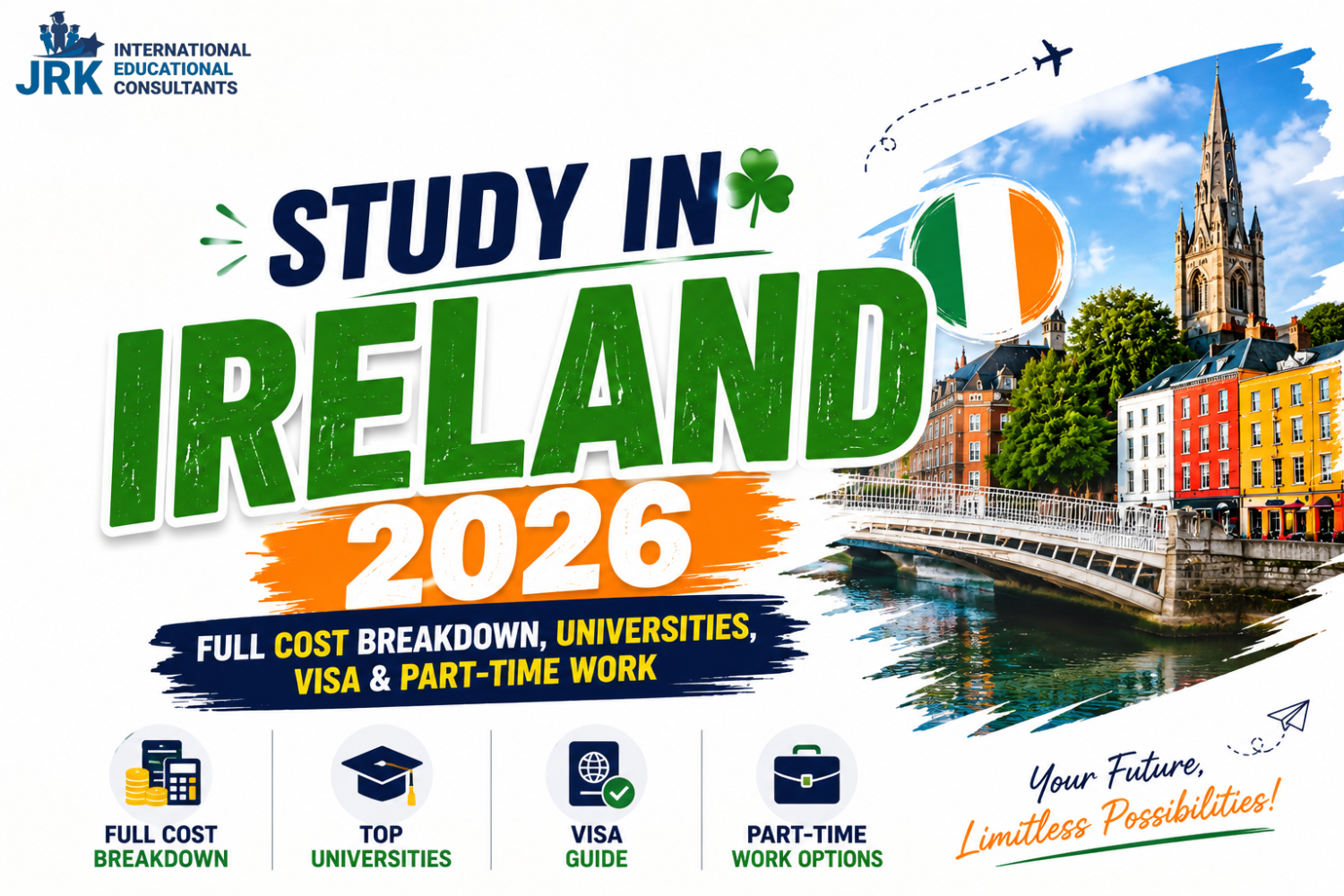
Ireland has become one of Europe's fastest-growing study destinations, thanks to English-taught degrees, strong graduate employability, and one of the longest post-study work visas among English-speaking countries. Here's the real 2026 cost and process breakdown.
Tuition fees
- Non-EU/EEA undergraduate: roughly €9,850–€28,000/year, with most mainstream programmes falling between €15,000–€25,000
- Non-EU/EEA postgraduate: roughly €16,000–€31,000/year
- Medicine, Dentistry, and other specialised programmes: significantly higher, often €45,000–€60,000+/year
- EU/EEA students: benefit from the Free Fees Initiative, which covers tuition for a first undergraduate degree — though a mandatory student contribution charge of up to €3,000/year still applies
Tuition typically increases slightly each year of a multi-year programme, so budget for the full duration, not just the first-year figure.
Cost of living
- Realistic monthly budget (excluding tuition): €900–€1,800, depending on city and lifestyle
- Dublin: the most expensive city — shared accommodation alone runs €600–€1,200/month
- Cork, Galway, Limerick, Waterford: 25–40% cheaper than Dublin, with living costs closer to €850–€1,200/month
- Visa requirement: non-EU students must show immediate access to at least €10,000 for living costs (for courses over 8 months), separate from tuition
Top universities to consider
- Trinity College Dublin — Ireland's oldest and most internationally recognised university
- University College Dublin (UCD) — strong across business, engineering, and sciences, with a large international student body
- University of Galway and University College Cork — excellent academic quality at a noticeably lower cost of living than Dublin
- Technological Universities (TU Dublin, Munster TU, Atlantic TU) — practical, industry-aligned degrees, often at a lower tuition point than traditional universities
Visa and residence permit process
- Secure your offer letter and pay the acceptance deposit (typically €500–€1,500, deducted from your first-year tuition).
- Prepare proof of funds: full tuition payment plus at least €10,000 for living costs.
- Apply for your student visa (single-entry or multi-entry, depending on your situation).
- On arrival, register your Stamp 2 immigration permission, which allows part-time work rights.
Part-time work rules
International students on Stamp 2 permission can work:
- 20 hours/week during term time
- 40 hours/week during official college holidays (June–August, and mid-December to mid-January)
At the current minimum wage (€14.15/hour, effective 1 January 2026), this works out to roughly €1,200–€1,230/month during term — enough to meaningfully offset living costs outside Dublin, and to contribute significantly even in Dublin, though it shouldn't be treated as your core funding source.
After graduation
Ireland offers one of the most generous post-study work visas in Europe: the Stamp 1G / Third Level Graduate Scheme allows 24 months for Master's and PhD graduates, and 12 months for Bachelor's graduates, to find employment and transition to a longer-term work permit — a genuinely strong pathway toward Irish or EU work experience.
Should you choose Ireland?
Ireland is a strong fit for students who want an English-taught degree with direct access to major multinational employers (Google, Meta, and other tech/finance firms have European headquarters in Dublin), and who value one of the longer post-study work windows in Europe. Budget-conscious students should seriously consider Cork, Galway, or Limerick over Dublin, since the academic quality is comparable at a meaningfully lower cost of living.
Source: Education in Ireland (official government portal), Irish Naturalisation and Immigration Service (INIS), and Citizens Information / gov.ie (2026 minimum wage).